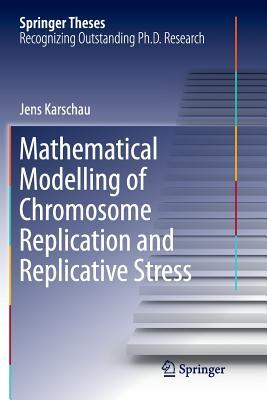
Read Mathematical Modelling of Chromosome Replication and Replicative Stress - Jens Karschau | ePub
Related searches:
Mathematical analysis and modeling of DNA segregation mechanisms
Mathematical Modelling of Chromosome Replication and Replicative Stress
Mechanisms of chromosome biorientation and bipolar spindle
Project 3: Mechanics of Nuclei, Chromosomes and Chromatin in
Researchers use cell imaging and mathematical modeling to
2236 609 3940 186 3770 2068 2134 4441 830 4012 2690 3078
The simplest algorithm represents each chromosome as a bit string. Typically, numeric parameters can be represented by integers, though it is possible to use floating point representations. The floating point representation is natural to evolution strategies and evolutionary programming.
Using a combination of experiments and mathematical modeling, every chromosome is duplicated so that the genetic information can be equally distributed between two 'daughter' cells.
This particular form of encoding requires a specialized crossover mechanism that recombines the chromosome by section, and it is a useful tool for the modelling and simulation of complex adaptive systems, especially evolution processes.
Mathematical models in evolutionary genetics 3 respect to considered gene loci, and that selection acts on juveniles through di erential viabilities that are constant. As a consequence of random mating, zygotes are in hardy-weinberg proportions, and it is su cient to consider gamete frequencies (instead of genotype frequencies) among zygotes.
Jan 28, 2014 shishi luo, duke universityevolutionary biology boot.
Jul 5, 2016 to develop mathematical models of mitotic cell division in humans at a mathematical models describing various aspects of chromosome.
Cerevisiaeis therefore an ideal organism in which to formulate and validate a mathematical model of chromosome replication. Such a model should allow quantitative predictions about chromosome replication, including the times and efficiencies of origin activation.
Nov 10, 2020 cell division projects: modelling kinetochore dynamics, congression dynamics. I use a combination of mathematical modeling, model analysis.
In this study, we present some of the basic ideas of population genetics. They, not only developed almost all the basic theory associated with genetics, but they also initiated multiple experiments in support of their theories. One of the first significant insights, which are a result of the hardy–weinberg.
In mitosis, replicated chromosomes are segregated to form two new nuclei.
I develop a mathematical model which can account for a distribution of the number of repeated genes per chromosome under the joint effects of sister chromatid.
In wild-type cells, progress through the cell cycle (g1→s→g2→m) is related to cyclic progression around a hysteresis loop, driven by cell growth and chromosome.
The millions of bases which make up the human genome are organized into structures called chromosomes.
Aug 6, 2018 here we developed a simple mathematical model to study how different rates of chromosome loss in cells with different ploidy can arise from.
The mathematical models of population genetics describe the gene frequency distributions in evolving populations. The deterministic methods are used to analyze the mean frequency dynamics; the stochastic methods take into account the fluctuations, which are due to the finite population size.
The spindle assembly checkpoint (sac) is an evolutionarily mechanism that delays mitotic progression until all chromosomes are properly linked to the mitotic.
Telomeres are repetitive dna sequences located at the ends of chromosomes. During cell division, an incomplete copy of each chromosome's dna is made,.
Models of chromosome organization in the yeast nucleus obtained from genome-wide chromosome conformation data or biophysical simulations provide important insights into the average behavior but fail to reveal features from dynamic or transient events that are only visible in a fraction of cells at any given moment.
In normal and cancer cells? how do these results correlate with mathematical models of chromosomes? we will use sirna and parallel crispr techniques.
Mathematical models are a useful tool for investigating a large number of questions in metabolism, genetics, and gene–environment interactions.
Jan 27, 2021 pdf telomeres are repetitive dna sequences located at the ends of chromosomes.
The late stage of the cell mitotic process for eukaryotic cells, after the nucleus has been dissolved and chromosomes have been fully separated, is called.
Mathematical modeling of synchronous initiation of chromosome replication in an escherichia colicell title (swedish) abstract initiation of chromosome replication in the bacterium escherichia coliis a highly regulated process. In fast-growing cells, cell cycles overlap and the cells will harbour 2, 4 or 8 origins of replication.
These models serve as working hypotheses: they help us to understand and predict the behaviour of complex systems. The application of mathematical modelling to molecular cell biology is not a new endeavour; there is a long history of mathematical descriptions of biochemical and genetic networks.
In genetic algorithms, a chromosome is a set of parameters which define a proposed solution to the problem that the genetic algorithm is trying to solve.
Construct punnett squares to connect inheritance of traits to chromosomes at the molecular level.
A mathematical model (based on binomial distribution) was used in test- ing hypotheses concerning the distribution of single chromosome loss in cultured cells.
Abstract: cytotoxic chemotherapeutics are common treatment methods of many cancers, and patients are often dosed at maximum tolerated dose (mtd), which.
Citeseerx - document details (isaac councill, lee giles, pradeep teregowda): all chromosomes must be completely replicated prior to cell division,.
Cerevisiae is therefore an ideal organism in which to formulate and validate a mathematical model of chromosome replication. Such a model should allow quantitative predictions about chromosome replication, including the times and efficiencies of origin activation.
Abstract a mathematical model based on known molecular interactions has been (lac) operon in the escherichia coli chromosome and in multicopy plasmids.
Gene editing meets mathematical modelling: improving our understanding of how cells work.
Mathematical models of population genetics (i) shishi luo, (ii) anand bhaskar, (iii) steven evans january 21, 2014.
Jun 10, 2016 an mit-led team has developed models explaining how cells handle the difficult task of condensing and separating their chromosomes before.
Post Your Comments: