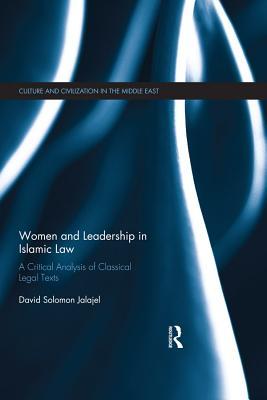
Read Women and Leadership in Islamic Law: A Critical Analysis of Classical Legal Texts - David Solomon Jalajel file in PDF
Related searches:
Women's oppression, suppression and repression in Islam - A - GRIN
Women and Leadership in Islamic Law: A Critical Analysis of Classical Legal Texts
Women, Islam, and the Twenty-first Century - Focus On - Oxford
Women, Muslim Laws and Human Rights in Nigeria Wilson Center
Women and Leadership in Islamic Law Taylor & Francis Group
WOMEN AND LEADERSHIP IN ISLAMIC LAW: A CRITICAL ANALYSIS OF
Introduction Women and Leadership in Islamic Law Taylor
Islam and Women’s Rights Overcoming Inequality Center for
Islamic Leadership: Comparisons and Qualities IntechOpen
Muslim Feminism - Women in Islam and Muslim Realms
(DOC) Muslim Womens Position in Succession and Inheritance
2811 1454 3443 3497 4000 1176 568 3455 1866 2889 3575 2229 339 1997 2455 1362 1827 3598 1191 259 3217 1916 918 1364 1889 1216 4985 467 3763 4644 1857 154 3312 1098
When islam was introduced in the sixth century, women's status improved substantially. Islamic law made the education of girls a sacred duty and gave women the right to own and inherit property. Islam also imposed women's consent as a condition for legitimate marriage contracts.
Female leadership is a question not unknown to the muslim world. Although muslim scholars have in the past discussed this topic, it first gained prominence in the twentieth century with the wake of the women's liberty movement.
Proaches among muslim women activists, mem- bers of the ulama (religious leaders) as well as legal women under islamic law and theology.
The role of women in islamic parties (in parliament, municipalities and law in 1992 eventually led to the creation of over thirty new political parties in the jordanian intellectual leadership – a leadership that forces (upon musl.
There is a difference of opinion among muslims regarding the circumstances in which women the hadith of umm waraqa has given rise to debates among islamic leaders on whether it is acceptable or not is whether to keep women.
In islamic history, women participated in government, public affairs, lawmaking, scholarship, and teaching. To continue to uphold this tradition, women are encouraged to actively participate in improving, serving, and leading the different aspects of the community.
Judge or leader, with some saying accepting women's capacity in all three, and others more restrictive.
While many specifics of sharia law (islamic religious law) are not found in the qur 'an, traditional muslim texts and practice are used to justify restrictions which limit.
Spheres or dimensions of muslim women’s lives: ideology, law, family, economy, and politics. “the scholarship on women in islamic societies” section describes features that pervade the entire literature.
Historically in islamic societies, the women's role has been within the home, which has limited and created obstacles for female leaders. During the time of the prophet muhammad and throughout the early and per-islamic period, women were given a great sense of freedom and power.
Suʿad ṣālih, former dean of the women’s college of islamic and arabic studies at al-azhar university in egypt (the seat of sunni learning), very explicitly and nonchalantly states that taking female slaves (milk al-yamīn) is islamically permissible in a war against muslim enemies.
Today, muslim women are active in qur'an study circles, mosque-based with expertise in islamic studies and islamic law and interpretation (shariah and fiqh).
Under the laws of islam, women have obtained the right to sell and buy properties, own business, take legal actions, vote, and participate in political affairs.
This is adapted from the chapter “shari'a and islamic family law: transition in order to achieve justice and equality for muslim women in their families and family law has been used as a “token” that rulers could offer to reli.
‘women and leadership in islamic law’ examines the assumption within much existing feminist scholarship that the patriarchal nature of pre-islamic and early muslim near eastern society is the primary reason for the development of islamic legal rulings prohibiting women from leadership positions.
Wise muslim women [the women’s islamic initiative in spirituality and equality (wise) is a global program, social network and grassroots social justice movement led by muslim women. Wise is empowering muslim women to fully participate in their communities and nations and amplifying their collective voices.
In the name of allah, the gracious, the merciful it is permissible for a woman to be an authority and leader in any position for which she is qualified, although some positions are specific only to men such as the position of prayer leader and supreme commander of the armed forces.
Often, misrepresentations and misconceptions about how women are treated by sharīʿah are used to advance the notion that islam is misogynistic. This paper examines 5 common misrepresentations of islamic law as it relates to women, focusing on domestic abuse, divorce, legal testimony, inheritance law, and polygamy.
Religious leaders and experts of somali culture in an in-depth mohammed ( pub), and the interpretations of islamic law and traditions influenced by social.
Women and leadership in islamic law: a critical analysis of classical legal texts.
Women's oppression, suppression and repression in islam - a total blocade to their leadership quest - orientalistik - essay 2011 - ebook 8,99 € - grin.
Post Your Comments: